
The Real Presence
The word, "real" can refer to different types of realities. There are physical realities which we perceive with our senses; spiritual realities such as angels and souls which are not material; symbolic realities, which are physical objects which bring something else to mind such as a flag; and sacramental realities which transcend both physical and spiritual realities. When we speak of the "real" presence, it is this sacramental reality we are referring to.
"Transubstantiation" is a term defined by The Council of Trent to help explain what we are referring to in this reality. During the consecration, there is a change in the substance of the bread into the substance of the body of Christ, substance being the essence of what something truly is, not just the accidents of its physical appearance.
Our Lord said that when two or more are gathered in His name that He is present there. We also know that God is everywhere. Isn't this presence in the Eucharist "redundant?" If not, how is it different?
Before Jesus was born in Bethlehem, God was present in the world, yet He became present in a different way through the incarnation; he became physically present for a specific purpose: so that as a man He could suffer and die for us. Likewise with the Eucharist, while God is present everywhere, He became and continues to become present in a different way in The Eucharist: a sacramental way for a specific purpose.
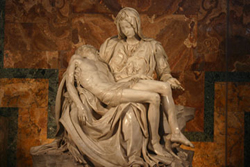
Primarily speaking, what is present in The Host? When distributing Communion, the priest says, "The Body of Christ." If we look at Michelangelo's Pieta shown above, we see what he is referring to: the lifeless body of Christ. Not to seem gruesome, but we are speaking of the dead Christ. In The Book of Revelation, when John sees the lion of the tribe of Judah (Christ) he sees a lamb standing as if slain. He sees a dead lamb, a sacrificed lamb. Christ becomes present in The Eucharist at the moment of His death, making that perpetual sacrifice present before us on the altar. For what specific purpose? A sacrifice is made to honor God, to offer thanksgiving, and in reparation for sins. With Christ's perfect sacrifice present, we can make that offering to The Father and can also enter into it. That's what we mean when we say we "offer up" our sufferings and hardships; we unite them to the sufferings of Christ and offer them together with His perfect sacrifice made present at The Mass. We then share in Communion by taking in the body of Christ into our own bodies. Our Lord said that unless you eat the flesh of The Son of Man you have no life in you. You can't eat the flesh of The Son of Man unless you have that flesh present before you.
But you may say, "God is not dead." What about the "body, blood, soul and divinity?" Isn't that what the Real Presence is all about?
This refers to another aspect of Christ which is the hypostatic union. Jesus has two natures, a human nature and a divine nature, but He is one person. His human and divine natures are united (the hypostatic union). Where is Jesus "now?" He is glorified in Heaven at the right hand of The Father. When Christ's body, immolated on the cross at Golgatha 2,000 years ago is made present, bringing that sacrifice into the present moment, there is still only one Christ; He is one person. Therefore it is the whole Christ, body, blood, soul and divinity that is present, and when we receive his body, while it is the re-presenting of the sacrificed (dead) Christ, we are also receiving the full, living body and blood of Christ along with His soul and divinity.
But if we forget the primary reality of The Eucharist, that of it being the body of Christ, we can tend to forget how the presence of God in The Eucharist is any different from the presence of God everywhere and The Eucharist becomes merely a symbol in people's minds instead of the unique, awesome and powerful presence of God that it is.
A Drop of Clear Water is a lay support group for Catholic teens. Our goal is to bring together teens who love their faith, are committed to chastity, and are ready to explore the wonder and beauty of Catholicism.