
Extraterrestrials
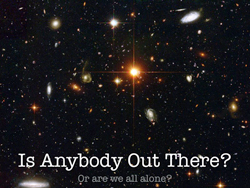
This photograph was taken from the Hubble telescope in orbit around the earth. The telescope was directed out towards deep space where nothing was visible in real time. A time lapse photograph then revealed this image. The individual lights are not stars but galaxies and astronomers estimate that there are thousands of galaxies in this view alone. Projecting this to the rest of the universe, we estimate that there are billions of galaxies out there, each of which have billions of stars within them, most with planets around them. In light of the vastness of the universe, we began our talk with a poll, "Do you believe there is life in outer space?"
After tallying our poll, we talked about the reasons for believing in things, why we believe what we do. We believe things because of direct evidence through the senses, and also through indirect evidence as is the case with gravity; we cannot see it but we can see secondary effects related to it. We also believe things because of reliable testimony; we believe that Napoleon existed, not because we saw, touched, or heard him ourselves, but because of reliable, substantiated testimony. In addition, we believe things on the basis of logical deduction; if a=b and b=c, we can conclude that a=c.
A 1996 Gallop poll reported that 72% of Americans believed in extraterrestrial life, and of those who did, 90% believed it to be more advanced than human life. Are we just "small potatoes?" The universe is indeed vast with billions and billions of stars out there, and the earth can seem to be insignificant being a relatively small planet orbiting a relatively small sun in a smaller than average galaxy. In the psalms, we read of man's wonder as he gazes upon the vastness of the universe: "When I see the heavens, the work of your hands, the moon and the stars which you arranged, what is man that you should keep him in mind, mortal man that you care for him?" How can we be of any significance in comparison to billions of galaxies? But the psalmist then goes on to say, "Yet you have made him little less than a god; with glory and honor you crowned him." -psalm 8.
Does being small imply insignificance? Bethlehem was a rather small, apparently insignificant place, but as the prophet Micah wrote, "And Thou, Bethlehem Ephrata, art a little one among the thousands of Judah: out of thee shall come forth unto me that is to be the ruler in Israel: and his going forth is from the beginning, from the days of eternity." -Micah 5:2.
Getting back to the reasons for belief, there is a difference between acknowledging the possibility of something being true and believing that something is true. The possibility of there being life in outer space is not affected by the vastness of space. Even if there were only one other galaxy out there, the possibility would still exist. But is it probable? Is there a reason to believe? The SETI (Search for Extraterrestrial Intelligence) Program has gone on for years without finding any direct or indirect evidence of extraterrestrial life. Any testimony we have has not been substantiated and has generally been questionable. The primary reason for people believing in extraterrestrial life is on the basis of logical deduction: given the vastness of the universe, it is likely that life has developed on other planets as well. The logical error in this deduction is considering the origin of life to be like the formation of a pearl in an oyster, which starts from the chance event of a grain of sand getting lodged in the oyster. The more oysters you have, the greater your chance of finding a pearl. Two former atheist scientists, an astrophysicist and an astronomer, calculated the odds of amino acids randomly associating into proteins and DNA to form even the simplest of single celled organisms to be one in 10 to the 40,000 power. Statistically speaking, anything less than one in 10 to the 50th power is considered "impossible." This means that life cannot arise by chance, and so the vast numbers of galaxies out there is irrelevant.
Believing something without a valid, rational reason for believing is called superstition. Is our faith in Catholicism superstition? We ran through the four reasons for believing something; while not having direct knowledge of God through our senses, we do have indirect knowledge; we can believe in God because of the design and order we see throughout creation. We believe in the revealed truths in scripture because of reliable, substantiated testimony of the miracles performed by Jesus and His Resurrection. And we believe in God through the logical deduction of the first cause.
We also talked about some remarkable findings in astronomy, including a discovery of an orderly distribution of quasars throughout the universe. Quasars are incredibly bright, about 100 billions times as bright as the brightest star. These bright lights have been found to be arranged in concentric spheres rippling out from a center point that is none other than our earth. Like the Star of Bethlehem, these quasars herald the significance of what appears to be insignificant, a spotlight on earth, the Bethlehem of the universe. It shouldn't surprise us. It was here after all, that the creator of the universe chose to enter into his own creation.
We have indeed been crowned with glory and honor. Being made in the image and likeness of God, we are called to be one with Him, even now in this life through prayer and Divine Intimacy. 2,000 years ago God became one of us so we could be come one with Him. There's nothing else in the whole universe that can even hold a candle to that.
A Drop of Clear Water is a lay support group for Catholic teens. Our goal is to bring together teens who love their faith, are committed to chastity, and are ready to explore the wonder and beauty of Catholicism.